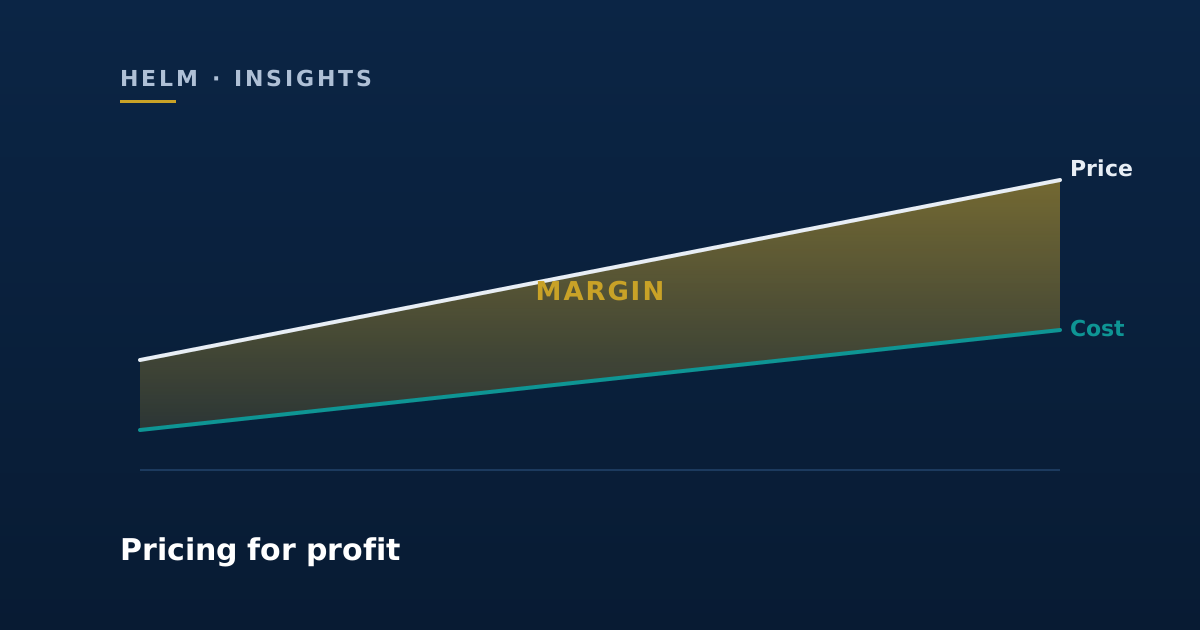
Pricing is one of the most consequential decisions a business makes, and one of the least systematically approached. Most SME owners set prices based on a feel for what the market will bear, what a competitor charges, or what they charged last year. Sometimes that works. Often it quietly bleeds margin in ways that only show up at year end, if they show up at all.
This is not about charging more for the sake of it. It is about understanding what your work actually costs before you set a number, so that the price you quote has a foundation rather than a guess beneath it.
Start with what the work actually costs
Before you can price correctly, you need a reliable unit cost. That means understanding what it truly costs to deliver one unit of your product or service, not just the obvious materials but the full picture.
Direct costs are relatively straightforward: raw materials, bought-in components, direct labour time on that specific job or product.
Indirect costs are where most businesses underestimate. Every quote you write, every delivery you make, every hour of management time that touches a job, every piece of equipment that wears out a little faster because of it. These costs are real. They need to live somewhere in the price.
A common shortcut is to apply an overhead recovery rate: take your total indirect costs for a period, divide by your total direct hours or units, and add that rate to each job. It is imperfect, but it is far better than ignoring the question.
Do not forget your own time. Many owner-operators price as though their own hours are free. They are not. If you spend 10 hours on a job, that is 10 hours you did not spend on something else. Your time has a cost.
Gross margin: the number that matters
Once you know your direct costs, you can calculate your gross margin: the difference between what you charge and what the work directly costs you, expressed as a percentage of the price.
Gross margin is what you have left to cover your overhead and generate profit. If your gross margin is too thin, no amount of volume will fix it. You will just get busier losing money.
The right gross margin target depends on your sector and cost structure, but the principle is universal: know what yours is, know what it needs to be to cover your overhead and leave a profit, and price from that number rather than backward from what you think the market will accept. A Grenadian tourism operator, an import-distribution business, and a food-processing manufacturer will each land on very different targets, but each still has to start from a margin it has actually measured.
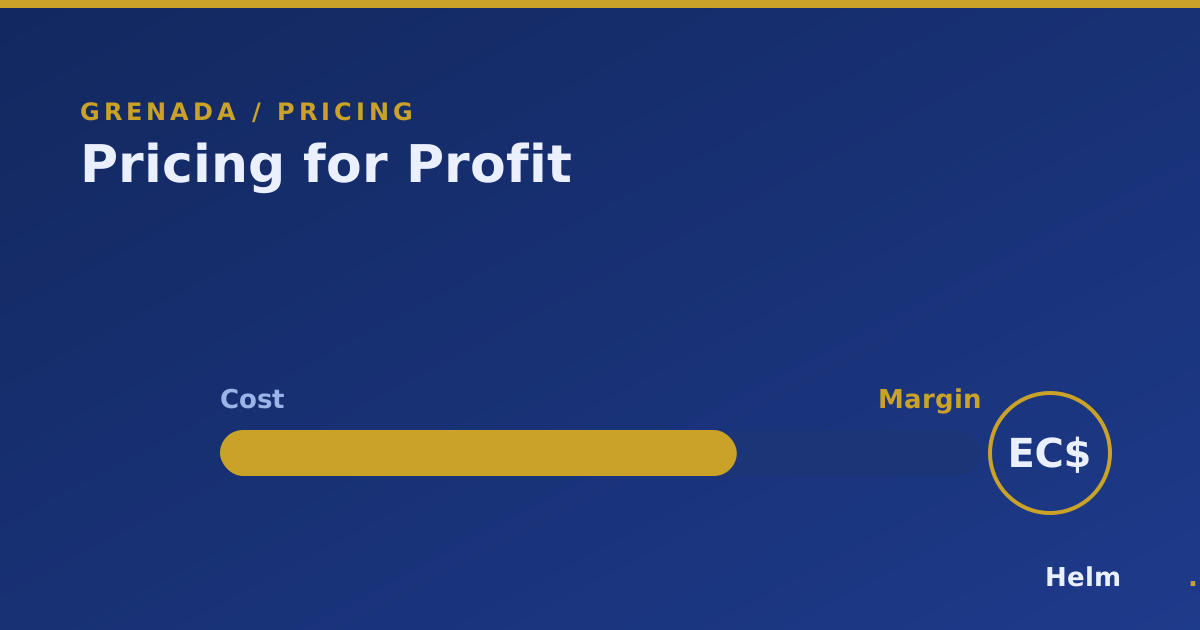 A 10% discount can quietly cut a healthy margin by a third.
Building VAT into the price
Decide early whether you quote VAT-inclusive or VAT-exclusive, and be consistent about it. In Grenada, VAT is charged at 15% (10% on tourism accommodation), while in Trinidad and Tobago it is 12.5%, so the same headline price is built up differently depending on where you trade. A price quoted “plus VAT” to a registered business customer reads very differently from a VAT-inclusive shelf price to a walk-in consumer. Confusing the two is an easy way to either scare off a buyer or quietly absorb the tax out of your own margin.
The problem with cost-plus
Cost-plus pricing (add a markup to your costs) is a reasonable starting point, but it has limits.
If your cost estimates are wrong, your price is wrong. And cost estimates are frequently wrong, especially for project-based businesses where scope can drift, jobs run long, or materials prices move.
The discipline is to track actuals against estimates on every job. Over time, that data tells you where you consistently underestimate and where your quotes need adjustment.
Value and the market
Cost-plus tells you the floor. The market sets the ceiling. Between those two numbers, there is usually more room than SME owners assume.
If your work is reliable, if your quality is demonstrably better, if you are faster or you provide something a cheaper competitor does not, those differences justify a higher price. The mistake is assuming that the only competitive lever is cost.
Clients who buy on price alone tend to be the most demanding, the slowest to pay, and the first to leave. Winning work at a proper margin is not just better financially. It tends to attract better clients.
Common pricing mistakes
Quoting without knowing your costs. If you do not know what the work costs you, you do not know if the price covers it.
Letting old prices drift. Costs change. Labour, materials, fuel, overhead. A price that was fine two years ago may be unprofitable today if it has not been reviewed.
Discounting to close. A 10 percent discount sounds modest. On an EC$10,000 job at a 30% gross margin, a 10% discount cuts margin to roughly 22%, a meaningful hit that has to be recovered on volume.
Not tracking job profitability. If you do not measure profit by job, product, or service line, you cannot know which part of the business is making money and which is not.
A practical starting point
If you have never formally costed your work, start with your three most common jobs or products. Whether you are a Grenadian retailer, a hospitality operator, or a wholesale distributor, the exercise is the same. For each one, build up the direct cost from first principles: materials, labour hours at an honest rate, any direct overheads. Compare that to what you charge. Calculate the gross margin.
That exercise alone often surfaces surprises.
If you want to do it properly across the business, a margin analysis by product or service line is one of the most useful things a Financial Controller can produce. It tells you where to focus, where to reprice, and where to have an honest conversation about whether the work is worth doing at all.
Pricing strategy is part of every financial health review at Helm Financial. If you want an honest look at your margins and what they should be, book a complimentary review here.
Frequently asked questions
- What is gross margin and why does it matter?
- It is the difference between what you charge and what the work directly costs you, expressed as a percentage of the price. It is what you have left to cover your overhead and generate profit.
- What are the most common pricing mistakes?
- Quoting without knowing your costs, letting old prices drift as costs change, discounting to close, and not tracking profitability by job, product, or service line.
- Where should I start if I have never costed my work?
- Take your three most common jobs or products, build up the direct cost from first principles, compare it to what you charge, and calculate the gross margin.
Put this to work on your own numbers
Get a direct conversation about your numbers with a qualified Financial Controller. No obligation.
Request a complimentary review